SwarmRSI: Recursive Self-Improvement through Evolving Scientific Agent Swarm
SwarmRSI: Recursive Self-Improvement through Evolving Scientific Agent Swarm
Oct 14, 2026· ,,,,,,,,,,·
1 min read
,,,,,,,,,,·
1 min read
Qianru Meng
Xi Zhang
Konstantinos Papakostas
Congfeng Cao
Wenxiang Hu
Tianyi Lu
Xiao Zhang
Lun Zhou
Zaiqiao Meng
Zhaochun Ren
Xiaohui Yan
Yougang Lyu
Abstract
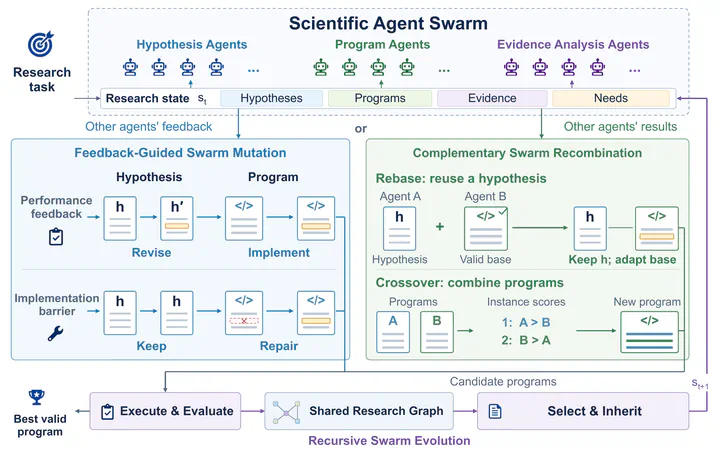
Recursive self-improvement (RSI) in scientific research aims to improve agents’ research capabilities through their own experimental experience. Scientific agent swarms can combine evidence and implementations from different research directions to guide their agents’ subsequent experiments. However, poor experimental results can leave unclear whether to revise a hypothesis or its implementation, while overall program scores can hide components useful to other agents. To address these challenges, we introduce SwarmRSI, a framework that evolves scientific agent swarms for recursive self-improvement. We devise Feedback-Guided Swarm Mutation to refine hypotheses and their implementations using experimental feedback from other agents. We also propose Complementary Swarm Recombination to reuse retained hypotheses and complementary program components across agents, allowing partial results to support new research. Recursive Swarm Evolution integrates both mechanisms into a feedback loop, using new experimental evidence to guide subsequent research. Experiments on OpenProblems, NatureBench and MLE-Bench Lite demonstrate SwarmRSI’s state-of-the-art (SOTA) performance. Further evaluations show that accumulated research experience improves performance on held-out tasks. Biologists also reproduce its programs for follow-up biological analyses.
Type
Motivation
Sharing experience across a scientific agent swarm does not by itself lead to better research decisions. A poor result does not show whether the hypothesis or its implementation needs revision, so promising hypotheses get abandoned; and a program without overall gains may still hold components useful to another agent’s later research.
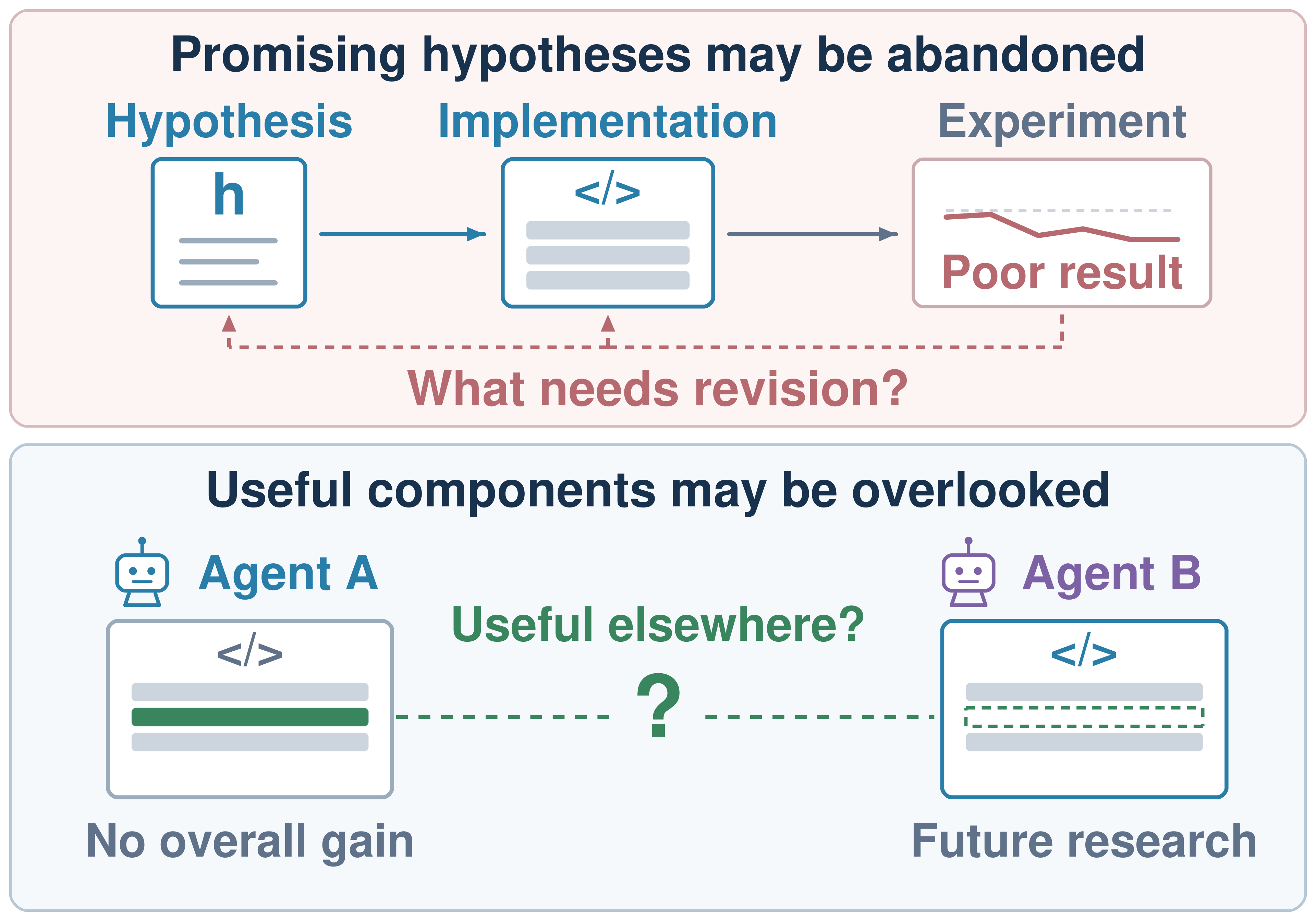
Two limitations motivating SwarmRSI.
Method
SwarmRSI evolves the research states that agents inherit — hypotheses, programs, experimental evidence and unresolved needs — through three mechanisms:
- Feedback-Guided Swarm Mutation uses other agents’ feedback to decide whether to revise a hypothesis or repair its program.
- Complementary Swarm Recombination tests retained hypotheses on other agents’ programs (rebase) and combines complementary program components (crossover).
- Recursive Swarm Evolution returns every outcome to a shared research graph that guides which state each agent updates next.
BibTeX
@misc{meng2026swarmrsirecursiveselfimprovementevolving,
      title={SwarmRSI: Recursive Self-Improvement through Evolving Scientific Agent Swarm},
      author={Qianru Meng and Xi Zhang and Konstantinos Papakostas and Congfeng Cao and Wenxiang Hu and Tianyi Lu and Xiao Zhang and Lun Zhou and Zaiqiao Meng and Zhaochun Ren and Xiaohui Yan and Yougang Lyu},
      year={2026},
      eprint={2610.20431},
      archivePrefix={arXiv},
      primaryClass={cs.AI},
      url={https://arxiv.org/abs/2610.20431},
}